Back to engineering archive

Record 065 / Sensing and instrumentation

LiDAR radio and timing-interface draft

Paired archived drafts send TFmini distance readings over RF24 and use a stored distance threshold in an OLED timing interface. Receiver packet handling and timing accuracy remain unverified.

Archived integration draft
TFmini APIRF24UARTOLEDEEPROM

Archived source flow
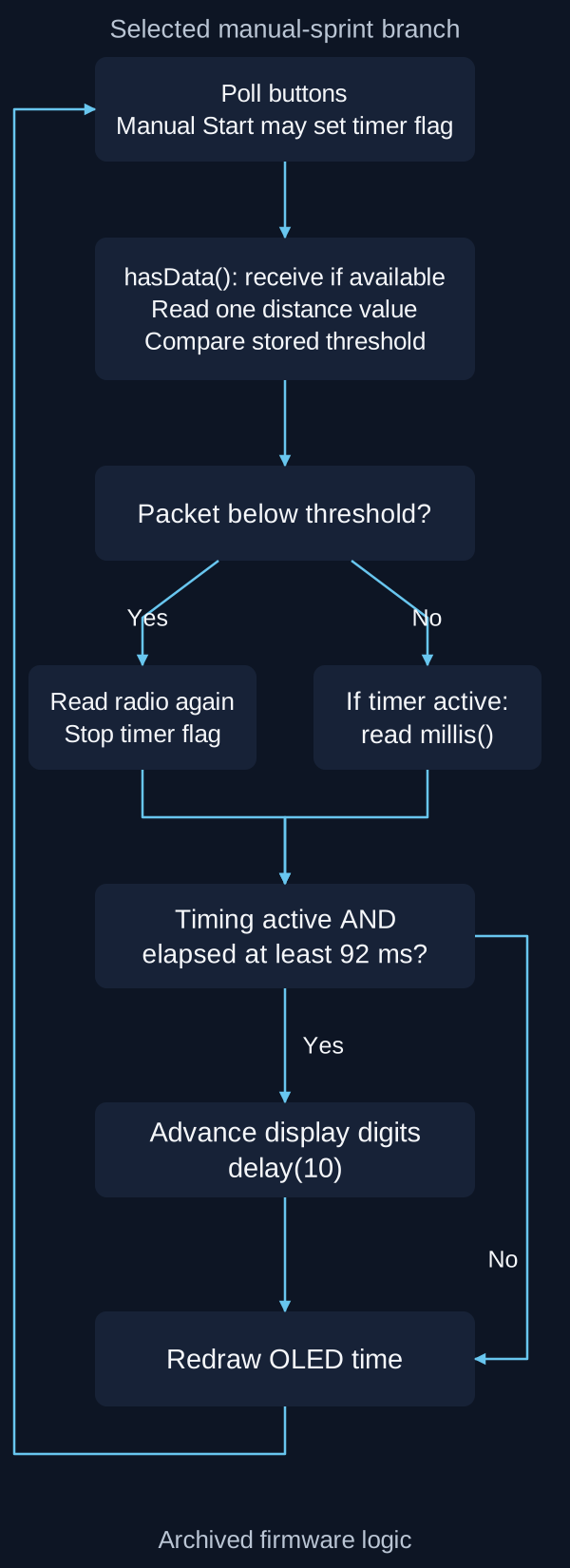
Selected manual-sprint branch of archived receiver source. Poll buttons; Start may set the timer flag. hasData reads an available distance payload and tests the stored threshold. A true result causes another radio read and stops the timer flag; otherwise millis is sampled when active. A92ms gate advances display digits and delays10ms, then the OLED is redrawn. Packet handling, board payload compatibility and timing precision are unverified.
Selected manual-sprint branch reconstructed from archived source. The helper consumes a radio payload before its caller reads again; timing and cross-board payload compatibility are unverified. View diagram at full size

Technical notes

Acquisition and radio roles

The sender reads the TFmini API through a hardware serial port, accepts positive readings below its upper limit and transmits a uint16_t distance using RF24. The receiver uses an OLED interface with sprint, lap and count menus, buttons and EEPROM-backed settings. It is RF24 code, not a BLE implementation.

Selected manual-sprint path

A manual Start action sets the timing flag. hasData() reads an available radio payload into an int and checks it against an EEPROM-derived threshold. Its caller then reads the radio a second time before stopping the timing flag. No packet is handed back by the helper, so that extra read is not a second validated measurement.

Timing and implementation limits

The display digits advance behind a 92 ms gate, with display work and mode-dependent delays; this is not established stopwatch precision. Sender uint16_t and receiver int payload sizes depend on board/toolchain compatibility. Some menu states lack corresponding timing branches, and no compiled cross-board build or physical start/finish timing test is verified.

Engineering archiveArchive record

Project enquiries

Discuss your project.

Tell us what you’re developing and where you need engineering support.

Discuss your project